

Capacity Before Power
Don’t Rush Past Lactate 1 and 2

Understanding lactate zones is important when planning and periodising effective swim training. The more clearly we understand an athlete’s physiological profile and the events they are targeting - the more precise intensity management becomes.
When we manage intensity well, we can identify what training prescriptions are genuinely helping an athlete progress and what is not.
Many world-class physiologists and coaches advocate that a high proportion of weekly training volume should sit at low-intensity aerobic paces. This work builds aerobic ‘capacity’ - not intensive aerobic “endurance.”
Low-level aerobic training develops an athlete’s aerobic potential carefully, whilst allowing them to swim with excellent technique or at least with enough energy to focus on it!
Lactate 1, Lactate 2
In previous posts, I’ve encouraged coaches to plan aerobic content with careful consideration. In this article, we’ll explore Lactate 1 and Lactate 2 intensities - where I believe aerobic prescription can sit safely, developing aerobic capacity rather than aerobic power.
Swimming at these intensities help keep weekly periodisation polarised, protecting key sets that require greater physiological commitment.
Most coaches are not physiologists. Therefore, we must make physiology simple - both for ourselves and for the athletes we coach.
Selling low-intensity swimming is an important coaching skill. Understanding how it supports athletes in the short, medium, and long term improves buy-in and ultimately leads to a better-prepared swimmer.
But we should be honest: low-level aerobic swimming is not as ‘fun’ as short sprints, relays, or high-intensity challenges. That’s why, beyond the long papers discussing low-level physiology, we must be able to articulate its purpose clearly and simply.
Lactate 1 mmol (La1) – Lowest-Level Aerobic Base
Lactate ≈ 1 mmol represents easy swimming - the softest aerobic intensity a swimmer can train at. The coaching instruction is simple: swim “easy”.
Some swimmers will need shorter repeats to maintain this low lactate value. Others can sustain it over medium or longer repeats, provided pace is adjusted slightly slower as repeat distance increases.
Technique should remain relaxed, controlled, with good mechanics throughout.
From experience, Blood Lactate 1 can be maintained for most swimmers approximately as follows:
100m PB + 20–30 seconds → 55s PB would see ~1:15–1:25 for BLa1
200m PB + 40–50 seconds → 1:55 PB would see ~2:35–2:45 for BLa1
400m PB + 70–90 seconds → 4:05 PB would see ~5:15–5:35 for BLa1
What’s Actually Happening at La1?
At this intensity, the body slowly upgrades its aerobic engine.
More mitochondria → Muscles increase their ability to produce energy by building more and better “energy factories” inside the cells.
Better fat usage → The body becomes more efficient at burning fat, sparing glycogen for when intensity truly matters.
More capillaries → An increased network of tiny blood vessels helps deliver more oxygen to working muscles.
Stronger recovery system → Athletes recover faster between sessions and tolerate higher overall training load (particularly helpful during multi-day competitions).
There is nothing dramatic about swimming at La1. No heavy breathing. No high lactate numbers. But consistent exposure to this intensity ensures these adaptations occur and are maintained. It builds a physiological system capable of handling greater pressure later - without breaking.
Coaching Insight
Considered aerobic volume, swum with excellent technique, should not be labelled junk mileage - it’s where aerobic capacity begins.
A suitable RPE for maintaining La1 is approximately 2–3 out of 10.
A larger aerobic base allows athletes to:
Absorb greater training load
Tolerate higher-intensity work
Recover more effectively from intensity
This is capacity, not power. Without sufficient capacity, power development can only progress so far - it will eventually stall.
Lactate 2 mmol (La2) - Moderate Aerobic Development
If swimmers slightly increase effort, blood lactate will likely rise to 2 mmol (La2).
This is still a relatively low lactate value and physiologically manageable. However, it is no longer just easy movement. It requires either a slight increase in pace or longer repeat prescription from the coach. The body works a little more, but energy production remains predominantly aerobic.
Think of La2 as economical “cruising.” It is not a competitive pace. The swimmer should not feel like they are grinding or fighting to make repeat times. However, they are now moving at a speed that requires more focus and rhythm.
La2 forms the bridge between easy swimming and threshold-type work.
From experience, Blood Lactate 2 can be maintained for most swimmers approximately as follows:
100m PB + 15–25 seconds → 55s PB would see ~1:10–1:20 for BLa2
200m PB + 30–40 seconds → 1:55 PB would see ~2:25–2:35 for BLa2
400m PB + 50–70 seconds → 4:05 PB would see ~4:55–5:15 for BLa2
A distance swimmer training high volume and a high percentage of threshold work may hold slightly faster than these recommendations. However, these swimmers often demonstrate limitations in pure swimming speed. I believe these guidelines are appropriate for athletes seeking to develop aerobic capacity while not neutralising speed.
What’s Actually Happening at La2?
This intensity continues to build aerobic capacity carefully. Beyond this level, training begins shifting from capacity development (aerobic potential) toward power development (aerobic utilisation).
Working at La2 supports:
Further mitochondrial development → Energy factories continue to expand and become more effective.
Greater contribution from Type IIa fibres → Speed-related fibres improve their aerobic capacity and become more fatigue resistant.
Improved ability to sustain moderate aerobic speeds → Swimmers can hold slightly faster paces with less physiological strain.
A smooth transitional intensity toward threshold work or paces that develop aerobic power
Coaching Insight
Well-trained athletes cope comfortably with La2.
A suitable RPE for maintaining La1 is approximately 4 out of 10.
If I prescribe La1 and a lactate check returns 2 mmol, I have no concern. However, it would be important not to increase pace or extend repeat length further.
La2 provides enough stimulus to produce positive aerobic adaptations, but not so much that technique deteriorates or recovery is compromised. It should feel purposeful and controlled. It should not create discomfort.
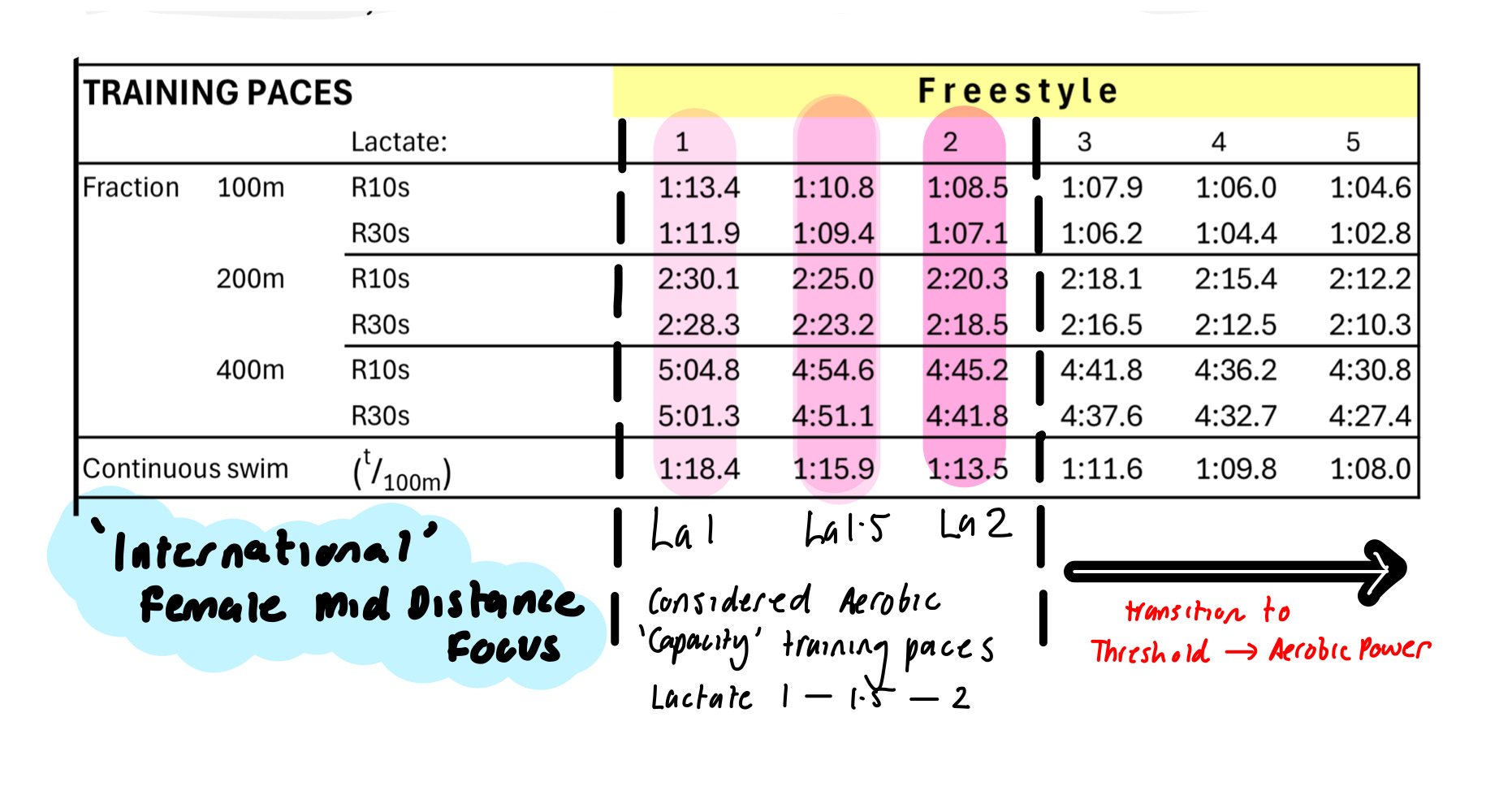
Below is an example of Blood Lactate paces used by an athlete I coach:
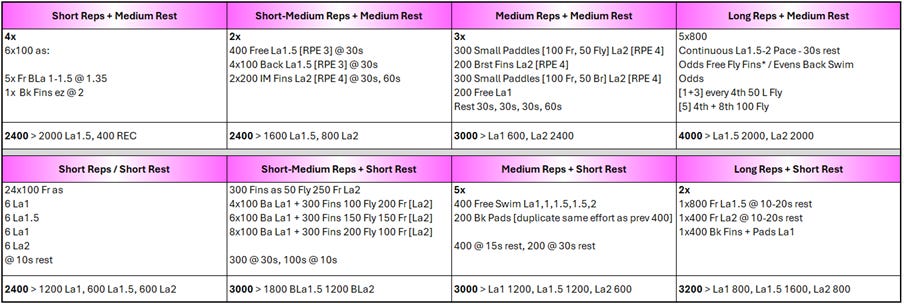
In addition here are a selection of training sets I have used when prescribing La1 and La2 intensity.
Hope you enjoyed this post! Please share with other coaches or swimming lovers!
For the training are you modifying the intervals to illicit the intended response?