

Streamline = Technique
Why one shape dictates drag, distance per stroke and sustainable race speed.

If there’s one technical constant I return to, it’s this:
Technique always anchors back to streamline.
Almost every coaching choice - drills, cues, priorities - improves the moment we ask one question:
“How does this help the swimmer hold a better line?”
Streamline isn’t just a push‑off position. It’s a shape that should live inside every part of swimming - drill selection, full‑stroke mechanics, even the work swimmers do on land.
That’s why mobility and stability matter so much. They’re the physical qualities that make good streamline possible. And it’s that streamlined shape which minimises drag and lets the propulsive phases actually do their job.
Great swimming can look powerful, but the real difference isn’t power - it’s how well the athlete streamlines through the stroke cycle to maximise distance per stroke and reduce drag.
There are moments when streamline isn’t the headline - teaching a scull, building feel, refining elbow path - but for most kicking, part‑stroke drills, and slow‑motion technique work, streamline is still the main priority.
Streamline Can Be Misunderstood
Streamline is sometimes thought of as ‘“arms together over your head.”
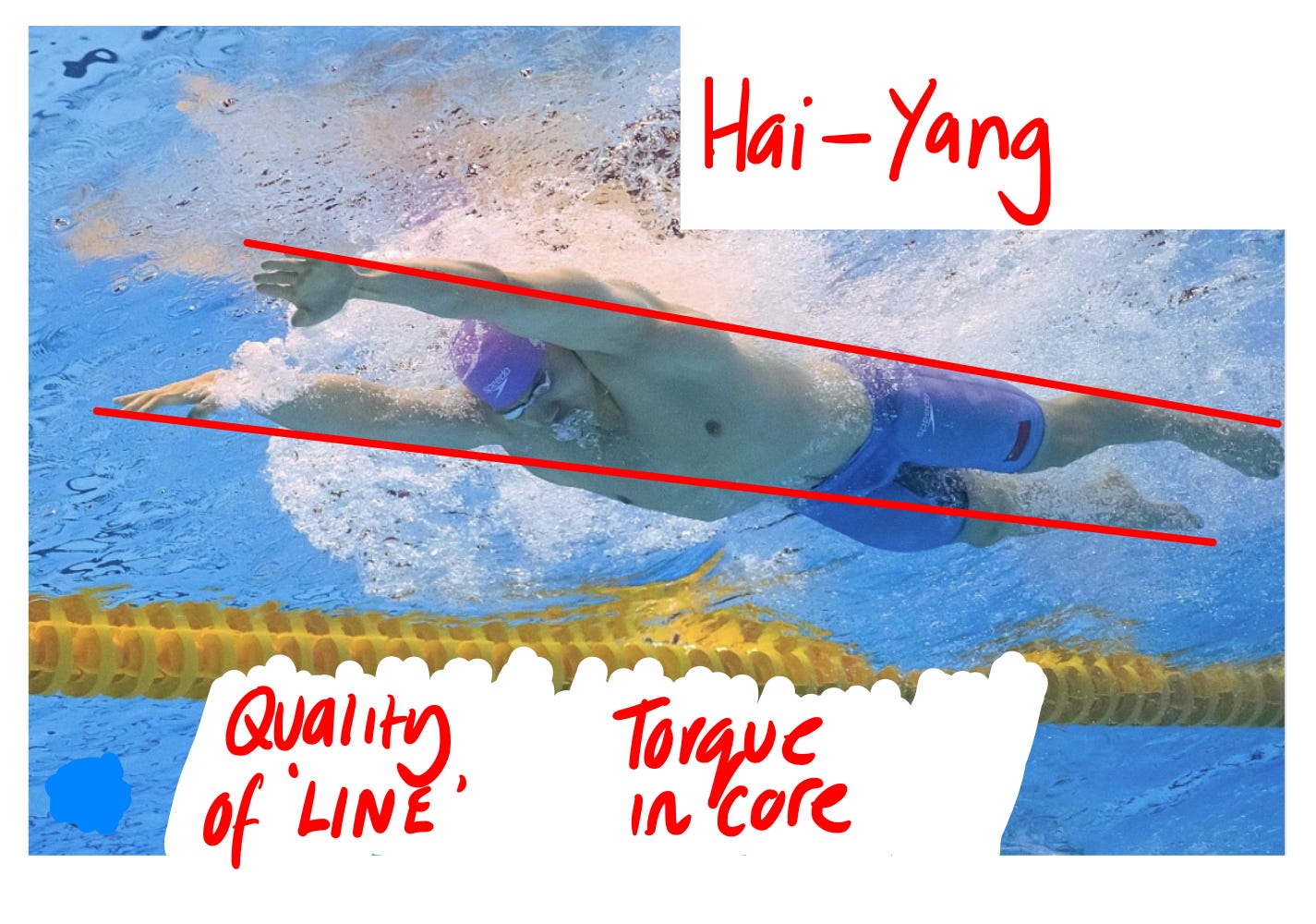
Its not. Streamline is a fingers‑to‑toes system with connection points you can literally tick off:
Wrists → Elbows → Shoulders → Spine → Hips → Knees → Ankles.
If any link is loose or weak, the line breaks.
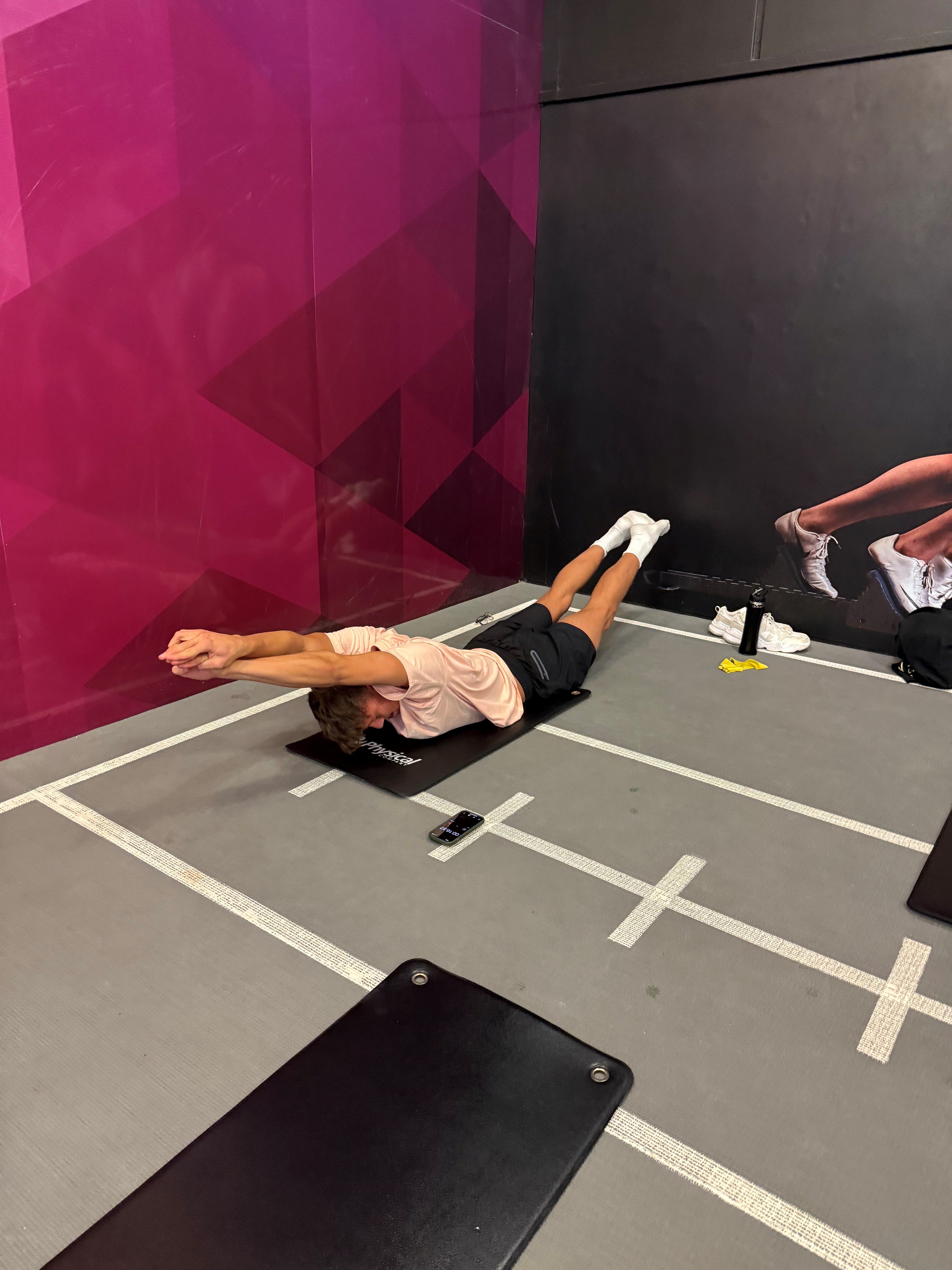
Ask a swimmer to stand tall, pull their belly button toward the spine, lock the elbows, stack the wrists, squeeze the ankles, rise onto the toes, and hold for 20–30 seconds. If they wobble or struggle to stabilise, holding their line in the pool, especially at speed, will be a challenge.
I like to think of it in this progression:
Develop range for a great line
Develop strength to control that range
Develop speed through that line
Building this on land and then teaching the transfer into the water is an effective strategy. And continuing to coach technical discipline throughout the session - in warm‑ups, technical subsets, and even the most challenging main sets - is a core responsibility for the coach.
When you look at it this way - range, control, then speed - the next question becomes: how do we coach this day to day?
Streamline isn’t a one‑off concept; it has to run through every stroke we teach.
Coaching Line in Butterfly
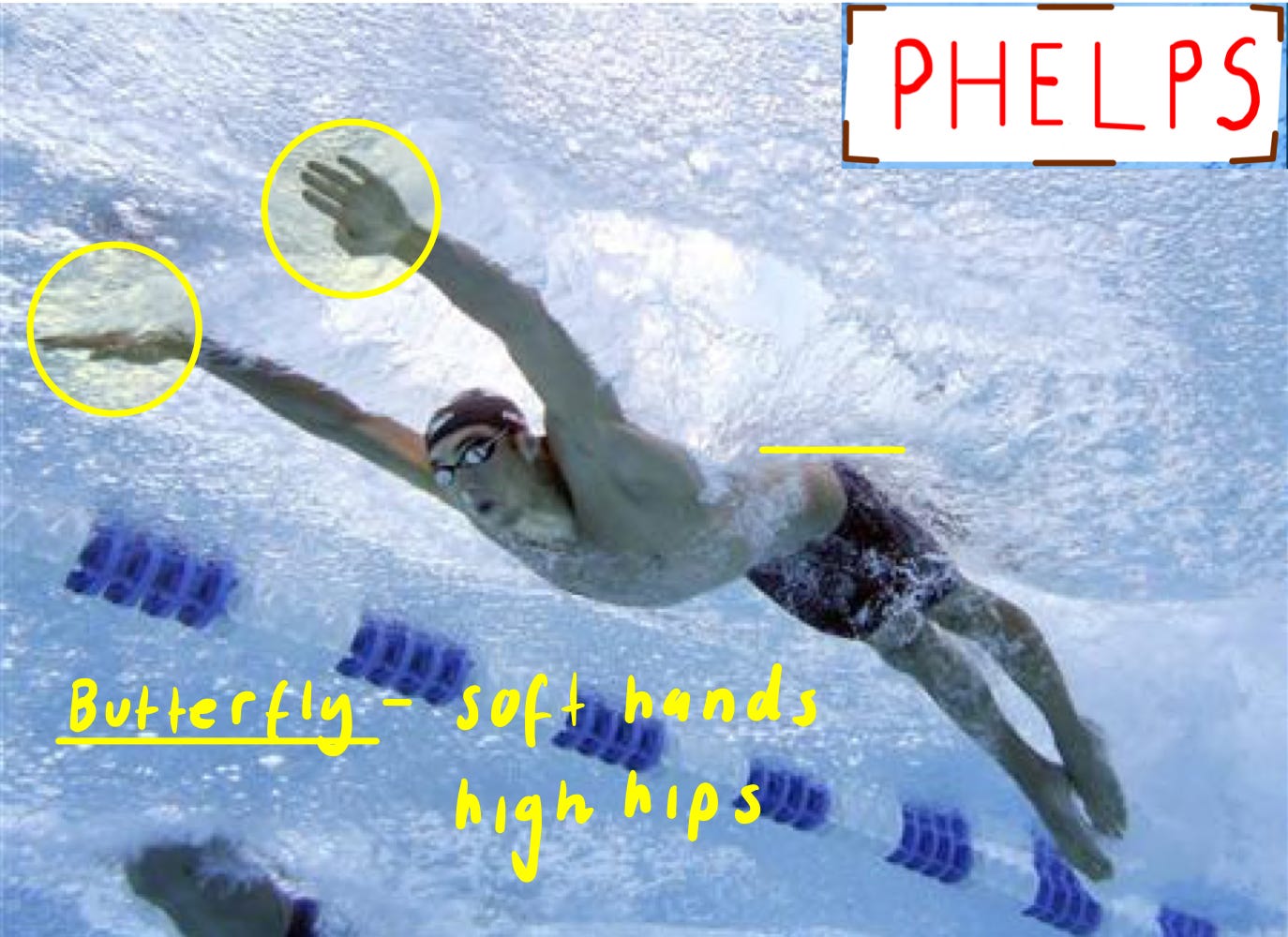
There are two areas in butterfly I chase constantly because they create drag and reduce speed.
1. Recovery → Entry Crash
Hands and forearms “chop” the surface on entry, creating a wall of frontal drag before the swimmer has even started to catch water.
2. Fatigue → Hip and Feet Drop
As the core and legs tire, the hips sink and the posterior kick fades. Early in a race you’ll see feet punching the surface rhythmically; late in the race those feet can vanish entirely.
Both problems anchor back to the same point: streamline quality.
The goal is to have a clean entry at the front and high legs at the back.
Why Single‑Arm Fly Works
A single-arm fly progression lets swimmers focus on both ends of the line without feeling overwhelmed by the full stroke. The instructions are simple:
Reach cleanly (soft and forward)
Create as little white water as possible
Kick the hand forward
Adding rhythm cues, especially acceleration through the kick in both directions, keeps the hips and feet high in the water.
Use:
Snorkel → keeps head neutral
Fins → helps rhythm and body position
Full stroke → once the pattern is formed
No fins → once rhythm is stable
Stroke count challenge → “How many strokes can you hold quiet entry?”
This progression is simple, but it helps the swimmer maintain greater streamline through their stroke cycles.
What It Looks Like When It Works
When the swimmer connects all the pieces, you see one continuous loop:
Quiet entry
High hips supported by a strong downbeat
High feet finishing with a crisp posterior kick
Clear forward rhythm through every cycle
The stroke stops being survival and starts being flow.
Coaching Line in Breaststroke
Drag punishes hardest in breaststroke.
Most swimmers try to increase their rate and wonder why they don’t get faster. Simple: they’ve added force and multiplied drag.
So start with positions.
Through the out‑sweep, the movement should be strong to fast.
Through the in‑sweep, the elbows wrap inward so that at the end of the phase:
Elbows sit under the shoulders
Forearms are tight in front of the chest
And the hands fire forward fast into streamline
Elite breaststrokers accelerate the arms so quickly that it’s almost impossible to see in real time. They apply pressure, move water, then instantly get back into line.
The kick tells the same story. During kick recovery, elite swimmers keep:
thighs flat
heels high
knees narrow
shins inside the hip line for as long as possible
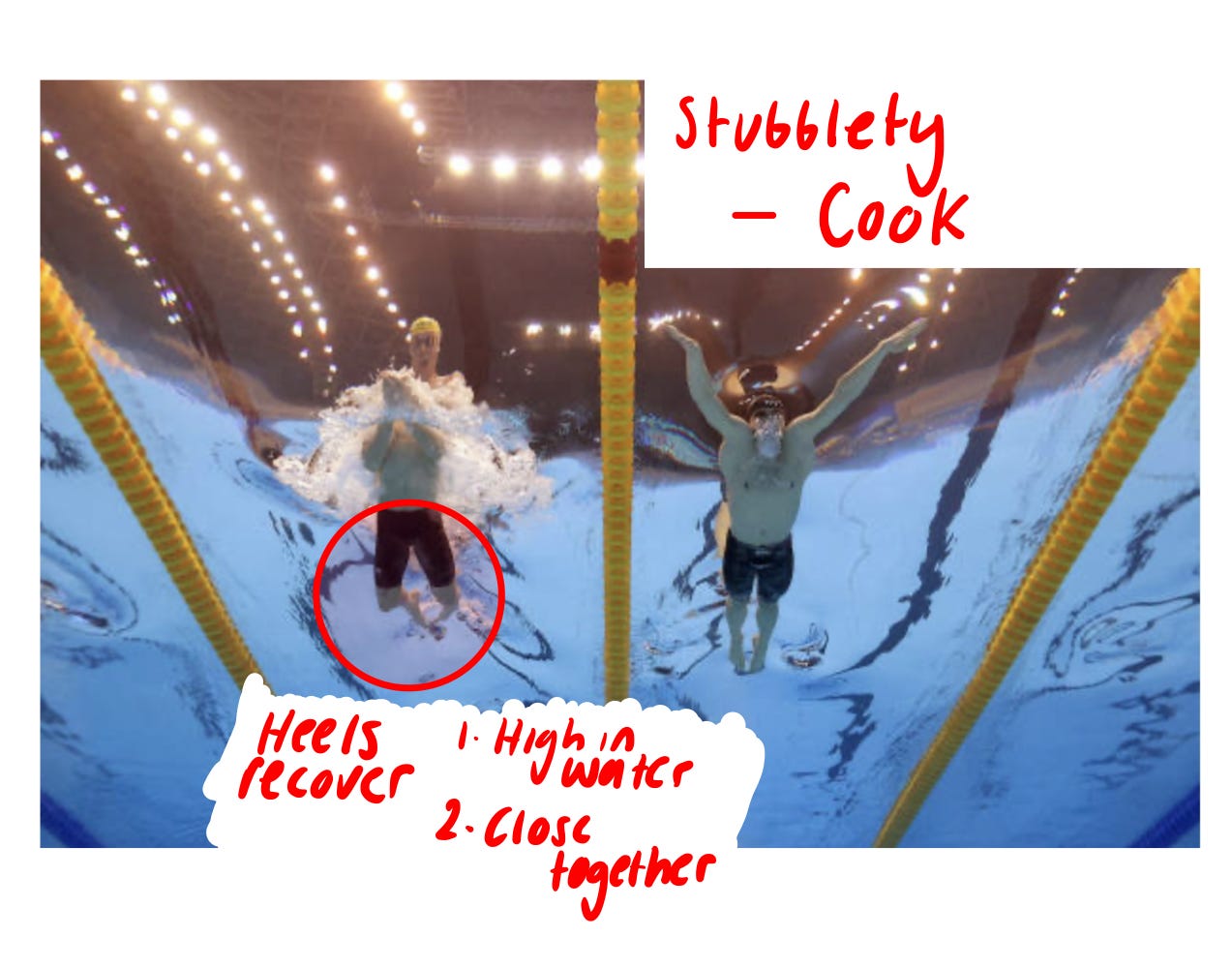
Any early flare is a parachute.
On the propulsive phase, force runs through the hips and glutes, finishing long with the feet high so the legs return to line - not trailing low.
If you want to see perfect streamline in breaststroke, show swimmers:
Kosuke Kitajima - thighs and shins almost the highest point during the cycle; drag shapes nearly non‑existent; the snap back to line is razor sharp.
Kate Douglas - incredibly flat underwater, huge propulsion, minimal drag.
Kate Douglass Underwater Video
Yes, they are phenomenal human beings with exceptional physiology. But their true superpower?
How ruthless they retain streamline throughouth their stroke mechanics.
Coaching Line in Free & Back
Free and back have endless legitimate stylistic variations.
You can coach balanced styles, hybrid styles - all great conversations to have. But no matter the style, one rule scales across them all:
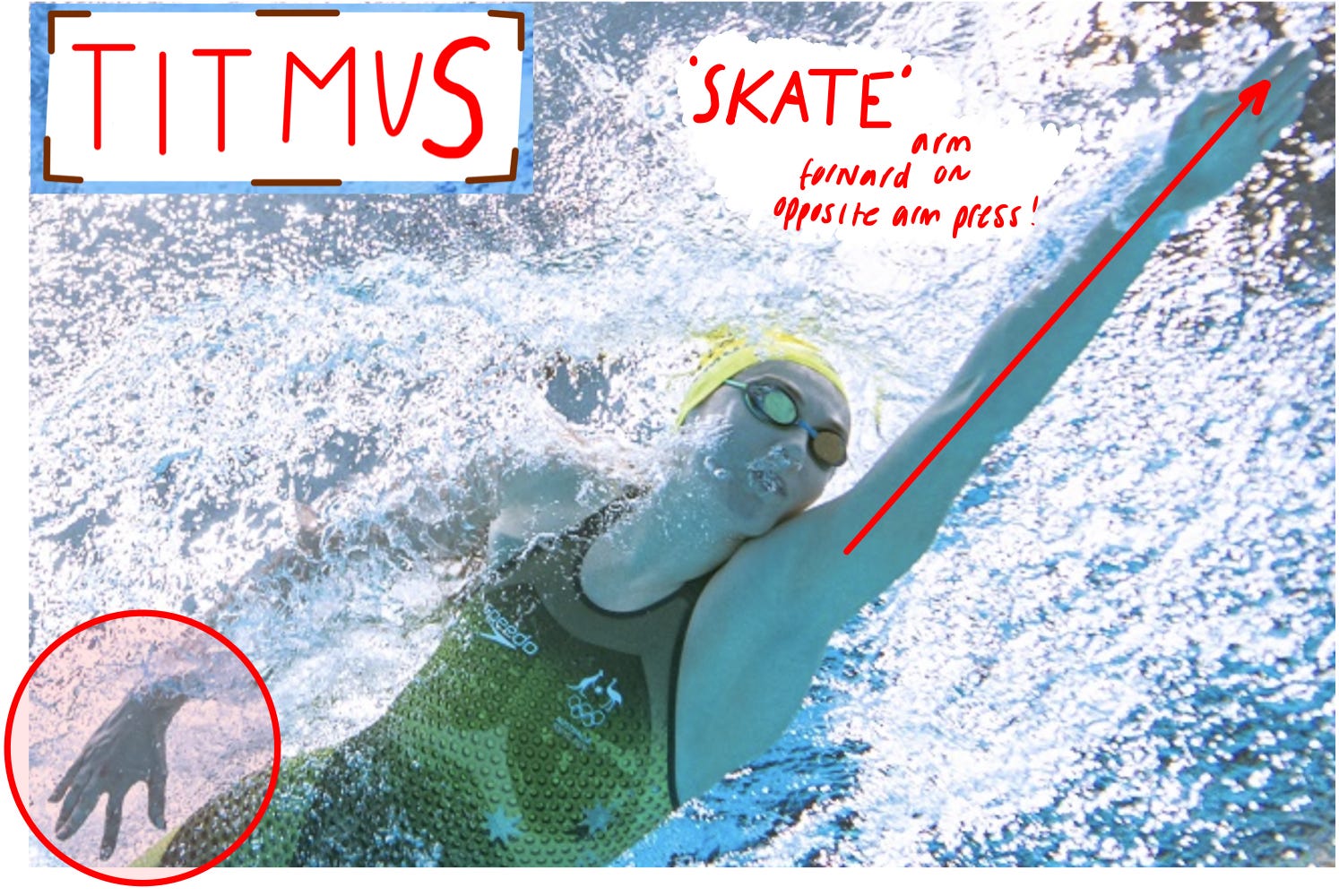
Long shapes beat short shapes.
And the most reliable cue I use is:
“Make your fingers and toes as far apart as possible, every stroke.”
That cue alone preserves DPS and teaches swimmers to apply pressure in long shapes.
Tight swimmers - thoracic spine, hips, posterior chain - don’t want to swim long. Under pressure and fatigue, they shorten, grab rate, and hope it helps. It rarely does.
Race analysis consistently shows that reactive late‑race rate spikes correlate with a drop in velocity. Tactical rate lifts are different: they’re layered on top of maintained line and rehearsed deliberately.
If a swimmer “can’t” keep fingers and toes far apart, the fix isn’t a better coaching cue - it’s:
Better range
Then strength in that range
Then build more rhythm using it
Starts, Turns and Underwaters
Skills are streamline exams in disguise.
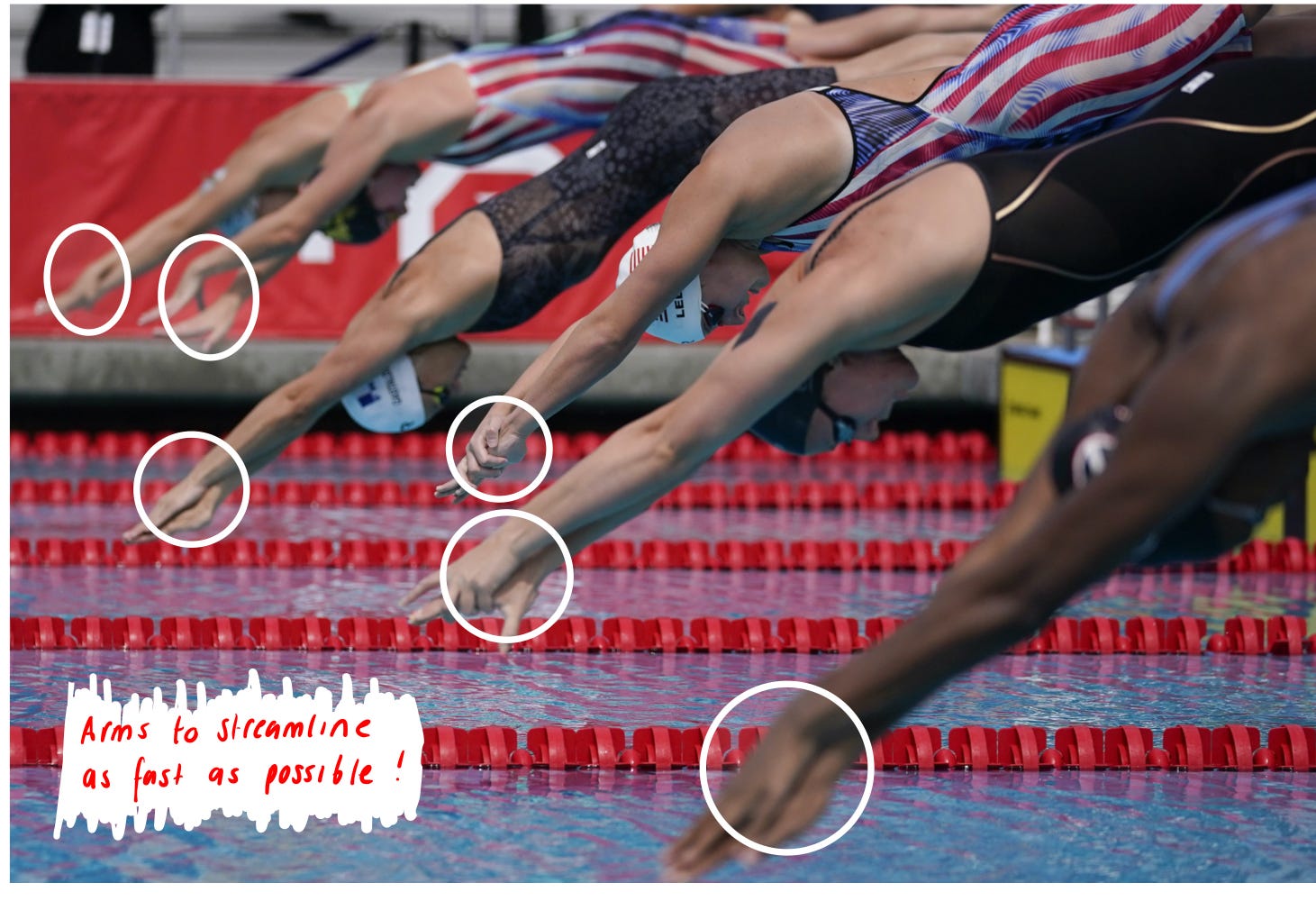
On the dive, the swimmer must hit tight streamline before water entry. But long before that moment, they must explode into flight, hitting a sequence of critical shapes. After reaching peak flight, the body must organise into a perfect line:
Head neutral
Elbows locked
Biceps tight to the ears
Ankles together
Toes pointed
Miss that shape - and the line can break. The entry may spear too deep. The breakout can becomes a rescue, not an acceleration.
Backstroke starts add another layer. The athlete needs all:
Strength to pull up
Ability to drive from the hips
Mobility to snap into streamline with hips as the highest point in flight.
And underwater Fly Kick? It’s often not a “kick problem.” More a range issue.
The world’s best underwaters often move their hands subtly up and down because they have such exceptional range that they can oscillate quickly around a neutral line.
Swimmers who lack the range for a quality streamline position often end up in in a slightly downward angle when they streamline. Their upper back becomes rounded, their chin tucks downward and their arms have to steer forward when they lock their elbows and stack their wrists.
Master streamline and skills will become more of a weapon.
Land Work
If the posterior chain and hip flexors are tight, swimmers will always prefer short, high‑rating strokes - especially under fatigue.
Which is why a simple pre‑water mobility and stability block makes a huge difference:
Hip flexor and posterior chain lengthening
Ankle plantarflexion work
Streamline holds
Reaching patterns
Core progressions
Good cues:
Belly button to spine. Elbows tight. Stack the wrists. Squeeze the ankles. Fingers and toes as far apart as possible.
Coaches should quickly learn to eyeball range in the shoulders, spine, and hips. Swimmers may resist working on range at first, but when they understand why streamline matters — “this is what enables you to swim faster and sustain speed better” - buy‑in skyrockets.
Link it immediately before the pool session and reinforce it with short underwater clips of elite streamline examples. The more you close that land‑to‑water loop, the faster the transfer.
Bring Streamline to the Front of the Session
Let’s be honest. Most young swimmers push off every wall with poor streamline - arms apart, legs apart, head up. Very little thought goes into maintaining a tight connection from fingers through to toes.
If we want swimmers to progress year after year, this has to change.
Start sessions with 10–15 minutes of streamline focus - on land and in the water. Warm‑ups, technical kicking, drills, slow motion swim work: all of it should be line‑guarded. Shape first, speed second.
This isn’t a list of drills; it’s a coaching lens. Whatever you’re teaching, ask:
“Does this help the athlete hold a better line and reduce drag?”
If yes, you’re building sustainable speed. If not, it only gets you so far.
The Point
Streamline = technique.
One shape that connects all strokes, all skills, all performance.
Improve range to make the shape.
Develop strength to hold it.
Build rhythm to move fast inside it.
Protect DPS under fatigue.
Don’t try to buy speed with excessive rate - you’ll only buy more drag.
And start every session by coaching the line - from fingertips to toes, every length, every day.
If you liked this article, please share it with other coaches!
Excellent post David. Great technique summary.