

SESSION BANK 10
AEC3 - Strong Design (with ways of 'softening' for younger swimmers)

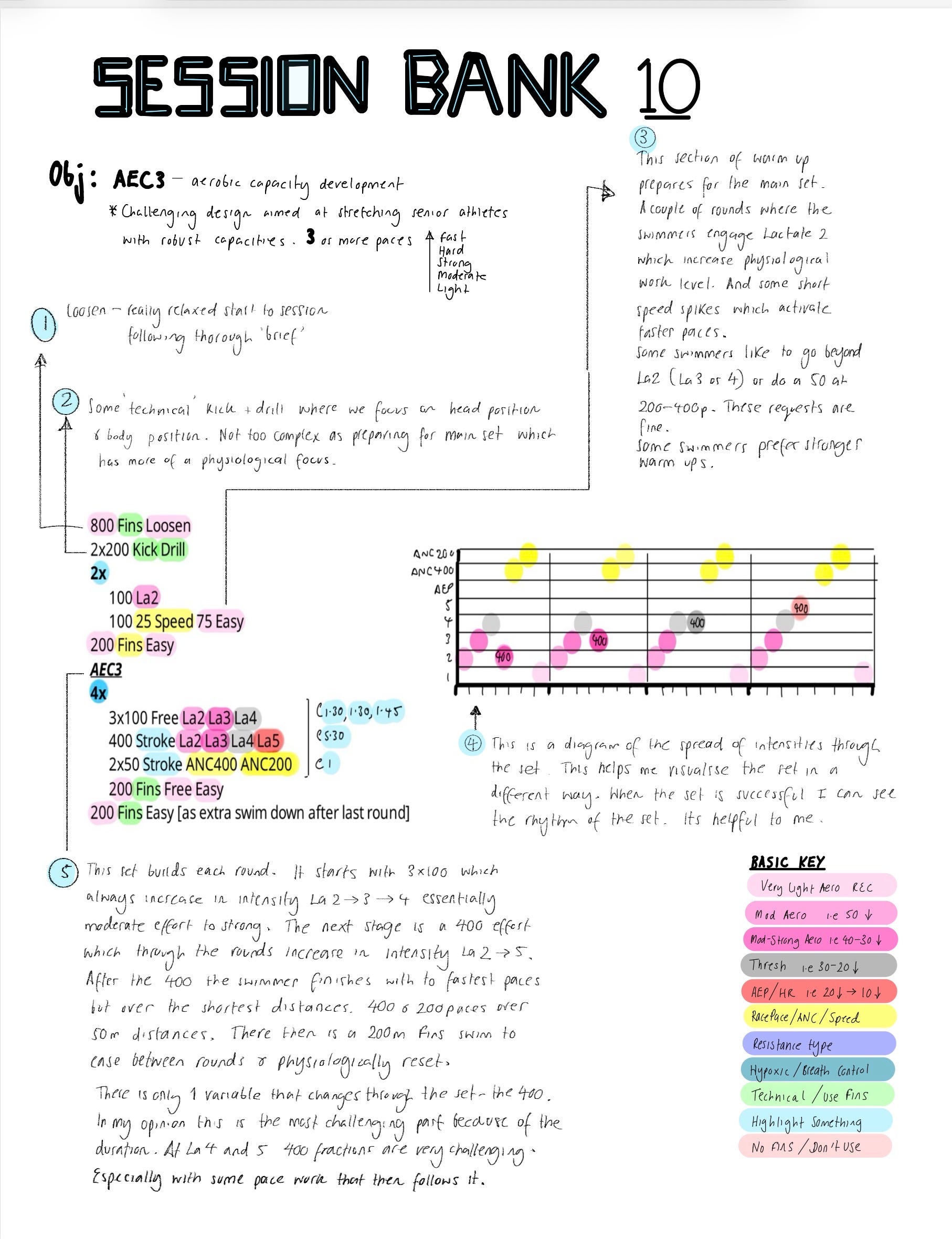
This session is an AEC3 aerobic capacity set - designed to challenge senior swimmers with a well-developed aerobic capacity.
Downloadable pdf version below:

An AEC3 set incorporates three or more paces, and the difficulty can be adjusted depending on how those paces are selected and layered. In this version, there are five distinct intensities, beginning at moderate and progressing through to hard and faster efforts.
Set Design Philosophy
The set uses a range of predominantly aerobic intensities, spanning from Lactate 1 through to Lactate 5.
Lactate 5 sits at the upper boundary of aerobic work, representing the “pinch point” where intensity begins to shift more significantly toward anaerobic contribution.
The aim of an AEC3 design is to:
Carefully select intensities that stretch the athlete
Expose the swimmer to a broad range of aerobic demands
Drive robust aerobic development through controlled progression
Structure Overview
The session consists of 4 rounds, each built around:
A sequence of 100s progressing through Lactate 2–3–4
A key 400m repeat (the primary challenge)
Followed by 2 × 50 pace swims
Then an easy reset
Key Feature: The 400
The defining element of the set is the 400m repeat, which increases in intensity across rounds:
Round 1: Lactate 2
Round 2: Lactate 3
Round 3: Lactate 4
Round 4: Lactate 5
This is the only variable that changes between rounds, allowing precise control of the session load without introducing unnecessary complexity.
Post-400
Immediately following the 400:
1 × 50 @ 400 pace
1 × 50 @ 200 pace
This combination reinforces pace control under fatigue before moving into recovery.
Training Effect
The challenge of this set is driven primarily by:
The progressive overload of the 400
The accumulated aerobic demand across rounds
The requirement to execute pace work under fatigue
For Olympic-level swimmers, this session produced an overall load of approximately 8/10 RPE.
On paper, the set may not appear excessively difficult compared to more aggressive designs you can find online, but in practice the layering of intensities and the progressive nature of the 400 create a highly effective and appropriate stimulus.
Adapting for Younger or Developing Swimmers
This set is not intended to be replicated directly by younger athletes. However, it can be adapted thoughtfully depending on training age and aerobic development.
Ways to Scale the Session Down
1. Reduce Volume
Drop from 4 rounds to 2 or 3
Maintains structure while making load appropriate
2. Remove the Descending 100s
Keep 100s at light aerobic intensity
Only progress intensity through the 400
3. Lower the 400 Intensity
Descend the 100s if desired, but hold the 400 at light–moderate effort
This creates a “sandwich” effect: intensity around a controlled aerobic swim
4. Shorten the Key Repeat
Replace 400 with 200
Example:
3 × 100 → 1 × 200 → 2 × 50
Significantly reduces physiological load
5. Modify the 50s
First 50 easy
Second 50 at pace
Provides partial recovery before speed work
6. Increase Rest Intervals
Add rest:
Between final 100 and 400
Between 400 and 50s
Supports better control and execution
7. Combination of multiple options above
Coaching Notes
This type of set is best suited to swimmers with strong aerobic training history
The intensity profile diagram (included in the session) is a valuable tool for visualising load distribution. Over time, coaches can use similar patterns to develop a clearer understanding of:
What intensity combinations work best
How swimmers respond to progressive aerobic challenges
Above all, the priority is appropriate application.
This is a high-quality aerobic design for advanced swimmers - but with thoughtful adjustment, the principles can be applied across different levels.
Hope you enjoyed reading Beyond The Blocks! :-)
As an age group coach I appreciate the scaled down section a lot.