

Integrating Physiological Models and Coaching Instinct
Science didn’t replace my coaching. It forced me to understand it better.

Note! I am not a physiologist! :-)
Coaching by instinct built my foundation
Over the years I’ve drawn from a range of systems. Australian models. American models. And now a European approach using Jan Olbrecht’s testing and framework. All of these models interlink from a physiological perspective, but the one that has helped me begin to prescribe training more accurately is the Olbrecht test and the conversation with Jan that follows around my pre-planned periodisation.
The Olbrecht test allows you to assess the size of an athlete’s aerobic and anaerobic capacities and how well, at that moment, they can utilise those capacities. In other words, their power.
The report provides a structured physiological insight that differs greatly from how I used to work, which was almost entirely instinct-driven. And in fairness, I still believe instinct. Combined with experience, it remains a very strong and reliable way of coaching.
The Olbrecht report offers accuracy. But it does not understand the person. As a coach, there are often things you simply believe an athlete needs to do to swim fast. Sometimes a report can steer you away from those instincts. And there have been times where I felt like I was planning against my own gut.
That tension has been my biggest challenge over the last year. Moving from a fully instinctive approach to one more informed by physiological profiling.
Letting science challenge the way I plan
I committed to following the Olbrecht reports carefully last season. I listened closely to Jan’s guidance to see what outcomes would emerge by the time we reached the World Championships. The results were strong.
For some athletes, his suggestions aligned with my instincts and I could apply them easily.
With others, the alignment was trickier. One example stands out.
A training progression I had considered aerobic power (AEP) was, in his framework, actually classified as Aerobic Capacity 3 (AEC3). That distinction mattered, because it meant I avoided that progression in the ‘belly’ of the cycle where I would previously have used it to sharpen the athlete.
We eventually discussed that misinterpretation. Had I understood the training categorisation better, I could have used that progression more appropriately. That was just part of the process we needed to go through as a coach and scientist learning how to speak the same language.
This season I challenged myself to combine scientific assessment and coaching instinct more effectively. To find a better balance between what the data suggested and what experience told me was needed.
It took a full year to really understand how the testing, tracking and planning integrate. But within that time the results have been good. Most notably, Freya Colbert was prepared to a physiological state where she was able to break Jo Jackson’s 16-year-old 200 Free British Record.
Physiology is not everything. But without the right balance of aerobic / anaerobic capacity and the ability to ‘use’ these engines (power), performances like that do not happen.
Where my physiological framework came from
Historically I planned training using the Urbanchek system. I studied this first whilst reading ‘Swimming Fastest’ by Ernie Maglischo. It helped me think in a physiological staircase. Light aerobic work first. Then stronger aerobic work. Then small doses of speed and race pace that became denser over time.
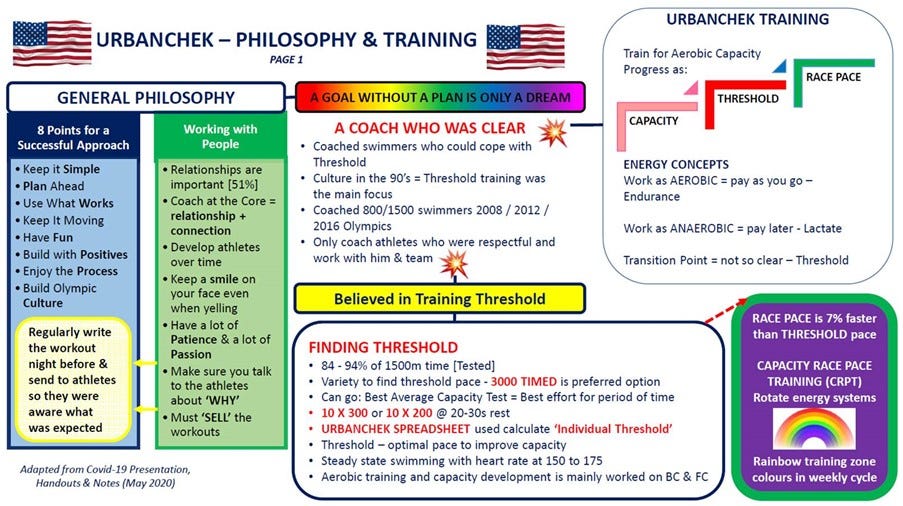
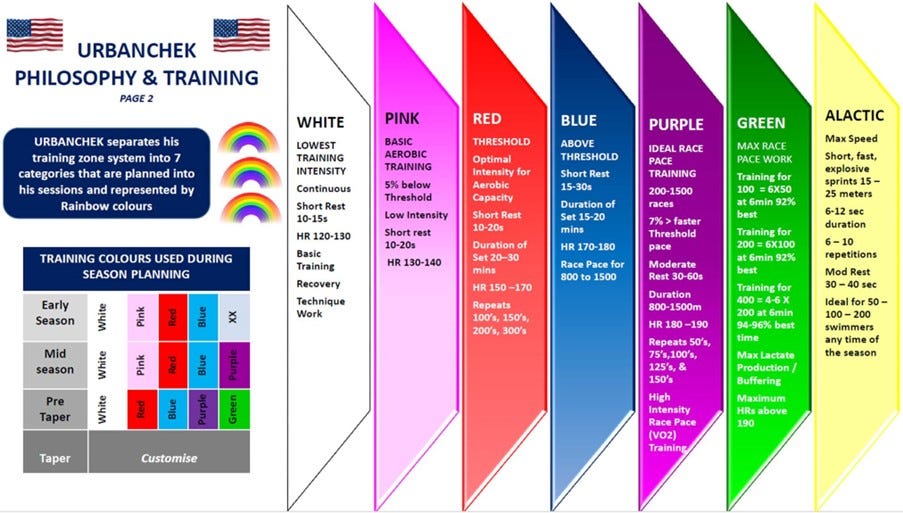
I would map the entire macrocycle in advance, then make small adjustments but rarely change the structure.
Before using Olbrecht testing, I often introduced threshold and heart-rate-based sessions early in the cycle. Jan would classify many of these as aerobic power. These sessions push physiological power up but can pull capacities down. They help athletes swim fast through training that enables them to use their aerobic and anaerobic ‘engines’.
Enough of this training can see athletes ready to swim very fast in quite a short space of time. And in a lot of seasons many of the fastest performances I have coached happened in April. I managed to get the athletes to peak performance by the end of Cycle 2 rather than Cycle 3. This is something I am working with Jan to try to improve.
To be fair, April is different. Athletes are chasing selection. The environment is more familiar and allows them to build into their best swim. That situation often helps execute a great swim.
Summer championships are harder. More rounds. More pressure. There is a requirement to swim close to or a best performance in the heats, recover and repeat. Without experience that can be a more challenging environment to deliver optimal performance.
Regardless of the differences between these types of competition, the power-dense January-to-April often delivered the fastest performance of the season before the Championship meet in the summer.
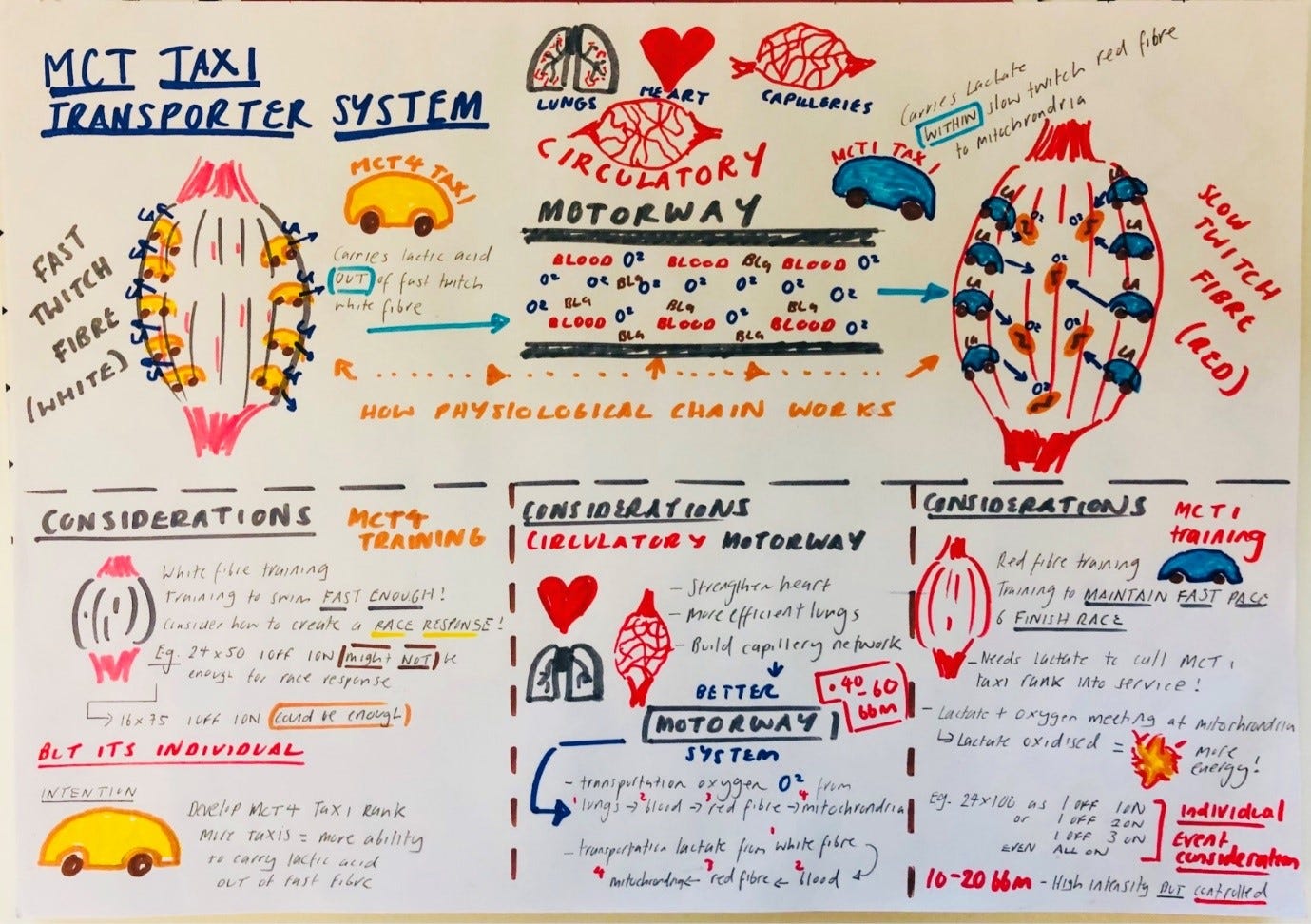
As time went on, I became more interested and influenced by Australian models, particularly Bob Treffene’s work. His focus on the central system and lactate shuttling made sense to me even if I did not always agree with some of the brutal periodisations that were published.
But what I took from his explanations was clarity.
A central system that acted as a ‘motorway’.
MCT4 ‘taxis’ that helped fast fibres carry lactate into the bloodstream.
MCT1 ‘taxis’ that helped other fibres take lactate in to the mitochondria to oxidise and re-cycle for more energy.
Whether that explanation is textbook perfect or not, the model made sense. Motorways. Taxi ranks. Flow.
I could design sets that targeted the right part of the system at the right time.
Quantifying what I used to feel
With the Olbrecht report, I can now quantify what I used to feel.
The model separates capacity (engine size) from power (how much of that engine you are using). The key is their relationship.
If power is already high, there is little room to improve without first growing capacity again. It becomes a wave.
Build capacity.
Then convert to power.
Then build again.
Mid-season testing might show high power but lagging capacity. That tells me to shift the next phase toward capacity before sharpening again.
Last season this helped me avoid overloading power work late in the cycle. Instead, once balance was achieved, I was able to prescribe lower-stress work as athletes freshened.
I also learned athletes respond very differently during rest. Some grow aerobically. Others shift anaerobically. One athlete I assumed was more ‘slow-twitch’ repeatedly showed rising anaerobic capacity during taper.
That changed how I manage their speed endurance.
Testing before and after racing blocks showed how short, intense competition cycles could power-up certain athletes. That insight now feeds directly into how I plan final preparation phases.
Where science ends and coaching begins
Even with detailed physiological reports, there is still an art in interpretation and subsequent planning.
Multiple tests. Careful tracking. Performance feedback. Observation. These all have to sit together.
The Olbrecht test helps design training structure. The coach has to bring it to life.
Understanding how each athlete’s physiology interacts with specific training units allows continual refinement in the balance between capacity and power. That balance, done well, gives athletes the best chance of delivering their best performances when it matters.
That is the space I am now able to work in. Inbetween science and instinct.
Great article ! Do you use HRV tests or something like this to have intermediate informations (regarding fatigue level) between Olbrecht tests ?
Absolutely brilliant, David - interesting you seem to have arrived at the Evidence-Based medicine approach I was taught during my degree on your own accord (shameless plug but I did a recent Substack discussing this approach in the context of things like coaching instinct: https://open.substack.com/pub/jacoblea/p/how-much-can-we-trust-sports-coaches?utm_campaign=post-expanded-share&utm_medium=post%20viewer)