

Developing Aerobic Endurance [Part 2] Threshold or Changing Gears - Training Set Examples

Many swimmers spend years doing “threshold” sets designed to build aerobic endurance. Yet these sessions often drift far beyond the intended physiological goal.
What should be controlled aerobic endurance development - essentially aerobic power at its most disciplined - can easily become too intense and increasingly anaerobic simply because the pace is pushed too hard partway through the set.
In my last post, I discussed the difference between developing aerobic endurance through flat threshold sets and through gear‑changing design.
In Jan Olbrecht’s categorisation, building aerobic endurance through changing gears falls under AEC3, although other training systems - such as Urbanchek’s Rainbow Sets - have long promoted similar approaches.
Both flat threshold sets and changing‑pace sets develop aerobic endurance, but they do so in physiologically different ways. The outcome depends on how the paces are managed, how the intensity fluctuates, and how deliberately the set is constructed.
In this post, I intend to give five examples of set design that illustrate the difference between:
a traditional flat threshold set
a poorly controlled threshold set
a ‘soft’ AEC3 set that develops aerobic endurance through varied paces
a more progressive AEC3 set that further stresses aerobic endurance (approaching AEP, or aerobic power)
a more intense AEC3 set suitable for physiologically strong endurance swimmers — such as world‑class 200m and 400m athletes
The intention is not to preach exact sets for every swimmer, but to encourage coaches to think more carefully about how aerobic endurance is developed.
The simplest place to start is with the traditional threshold set.
Set 1 – Traditional Flat Threshold
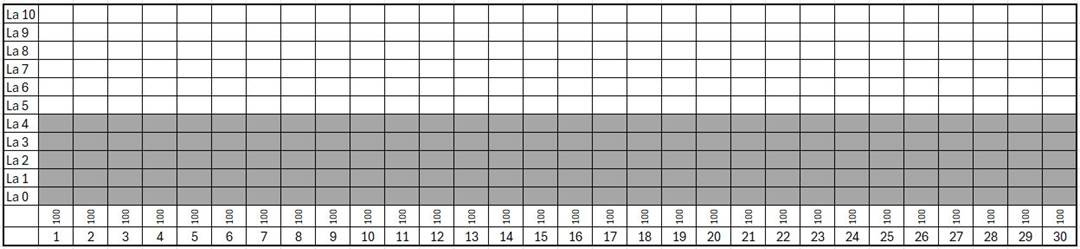
The first set is a very traditional threshold session: 30 × 100 holding a flat pace.
The goal is for the swimmer to hold a speed where blood lactate stabilises around 3-4mmol. At this intensity the small amount of anaerobic energy being produced can be cleared comfortably by aerobic metabolism. In practical terms, this means lactate levels do not rise significantly and the swimmer can sustain the work for the full set.
For most swimmers this corresponds roughly to: RPE 5–6 out of 10
For swimmers with a more available anaerobic profile, threshold might be easier to achieve than coaches realise. Sometimes closer to RPE 4.
Earlier in my coaching career I often prescribed threshold sets closer to RPE 7–8 with short rest. However, after working more consistently with lactate testing, I realised that swimmers can very quickly drift above true threshold if encouraged to swim more intensely. When that happens, the set starts to resemble the next example.
Set 2 – Poorly Controlled Threshold Set
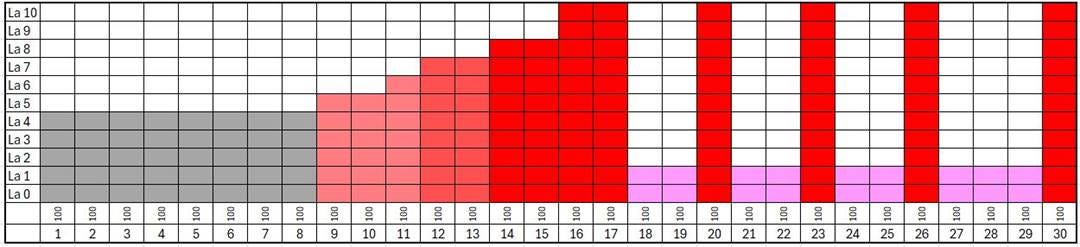
This set often starts exactly like Set 1. However, after around a 1/3 of the set, the coach begins encouraging the swimmer to go faster. This usually happens because:
the swimmer looks comfortable
the rhythm appears good
the coach feels the swimmer should “push on”
From around rep 9 onwards, the pace becomes too intense. Even if the coach is pleased with the swimmer’s effort and commitment, blood lactate begins rising above what can be cleared aerobically. The set gradually shifts into more anaerobic work.
By the middle of the set, the swimmer starts to experience significant discomfort. They present strained between repeats. At this point, the coach realises the pace is unsustainable and starts adjusting the set so it can still be completed.
This often leads to patterns such as:
2 easy / 1 fast
3 easy / 1 fast
Missing repeats
The swimmer finishes the session, but the objective of the set has already been lost. The error occurred earlier - when the swimmer was encouraged to increase intensity around repetition 9 or 10.
Earlier in my coaching career, I probably prescribed too many sessions that resembled Set 2. With more experience and with access to lactate testing I realised that my own motivation to push the group often changed the intended physiology of the session.
If this type of training happens regularly, it can create several problems:
excessive fatigue
excessive physiological stress
suppressed anaerobic capacity
increased illness risk
Even if young swimmers are able to battle through repeated exposure to this type of training, they will eventually become strong trainers but lack the physiological range needed to be outstanding racers.
Over time, they struggle to access speed and often develop technical faults because they are constantly training under fatigue.
Set 3 – ‘Soft’ AEC3 that Develops Aerobic Endurance Through Varied Pace
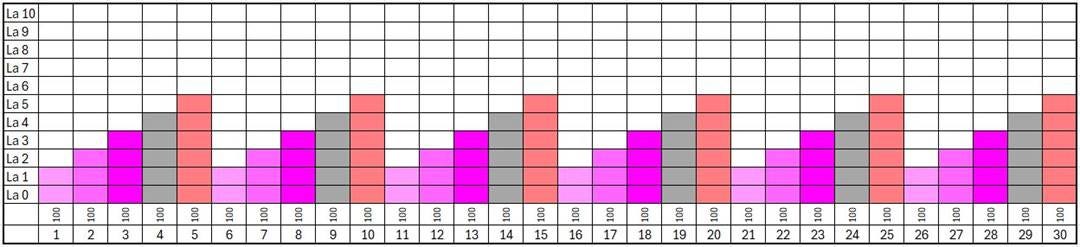
The third set introduces controlled variation in pace around threshold. The structure is again 30 × 100, but the intensity gradually increases over several repetitions before returning to easier aerobic work.
A typical pattern might look like:
La1 → La2 → La3 → La4 → La5
The fifth repetition slightly exceeds threshold before the pace drops back down.
This brief increase in intensity stretches the aerobic system and recruits additional fast‑twitch fibres (Type IIa) without allowing lactate to accumulate excessively.
Across the set, the pace typically oscillates by 9–10 seconds per 100 between La1 and La5.
For many swimmers this might look roughly like:
La1 – 100 PB +20
La5 – 100 PB +10
For swimmers with a more sprint‑based profile, the range may be slightly wider:
La1 – 100 PB +25
La5 – 100 PB +15
These are general guidelines rather than precise individual values, but they offer a practical framework for organising the set.
The key point is that the faster repeat should not be too intense. If the pace becomes overly fast, lactate will accumulate rapidly across the set.
During a capacity building phase, the goal is to stretch intensity slightly while maintaining control of overall physiological stress.
Set 4 – Progressive AEC3 that Further Stresses Aerobic Endurance (approaching AEP, or aerobic power)

This set gradually increases aerobic power throughout the session. It is best suited to an athlete with a well‑developed aerobic capacity who can tolerate some intensification within an endurance set.
Note: For many younger swimmers or athletes with a lower training age, this session would be too demanding; in those cases, a more cautious approach - such as Set 3 - is more appropriate.
An example structure would be 40 × 100.
Each subset — 5×100, 5×100, 6×100, 7×100, 8×100, 9×100 — descends from La1 → La5, but with one key change: each round includes one additional easy repetition and a slightly faster final repetition.
The final repetition of each round progresses through increasing lactate levels.
If La5 = 100 PB +10 seconds, the progression might look like:
La6 – PB +9
La7 – PB +8
La8 – PB +7
La9 – PB +6
La10 – PB +5
For swimmers with more sprint‑based profiles or weaker aerobic physiology, La5 might instead correspond to 100 PB +15, with the subsequent steps becoming PB +14, +13, +12, and so on.
In those cases, the set would typically be shorter - approximately 23–31 repetitions rather than 40.
The additional low‑intensity swimming between harder efforts allows the physiological system to partially reset before the next increase in intensity.
Although blood lactate does not return to baseline, the easier swimming enables the athlete to continue producing high‑quality efforts without becoming overwhelmed anaerobically.
This type of set also reinforces the concept of building pace through the session, which is essential for events such as the 200m and 400m freestyle.
At the world‑class level, 200m races often show only 2–4 seconds difference between halves, and the best 400m performances are exceptionally evenly paced.
Training sets like this help develop that level of pacing control.
Set 5 – More Intense AEC3 Set Suitable for Physiologically Strong Endurance Swimmers
[World‑Class 200m and 400m Athletes]
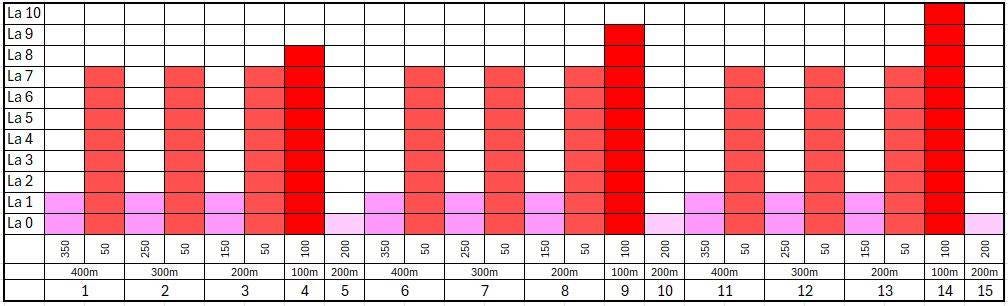
This is the most challenging session of the five examples in this post and should only be attempted by swimmers with a strong aerobic profile - typically senior or physiologically mature athletes.
The set structure is:
3 × [400 – 300 – 200 – 100 – 200]
Within each repetition, the challenge is to finish fast. For example:
400 – 350 La1 + last 50 fast
300 – 250 La1 + last 50 fast
200 – 150 La1 + last 50 fast
100 – entire repetition fast
After the fast 100, the swimmer completes 200 metres of easy swimming before beginning the next round. This helps the swimmers physiological system breath.
Across the 3 rounds, the intensity gradually increases, with the final 100 becoming progressively more demanding.
This progression causes lactate to rise each round, but the La1 prescription at the start of each repeat, combined with the 200m recovery, helps keep the swimmer broadly within an aerobic framework that makes the set achievable.
The challenge of finishing long repeats with fast final 50s is significant. Although much of the swimming occurs at aerobic pace, the repeated gear changes place considerable stress on the physiological system.
Final Thoughts
Aerobic capacity training is often straightforward:
moderate to long repeats
steady pacing
reasonable volume.
But once the goal shifts toward developing aerobic endurance - where more aerobic intensity and aerobic power are introduced - the way intensity is managed becomes critically important.
The organisation of intensity within a set can dramatically change the physiological outcome. Some programmes either promote, or unintentionally encourage, training sessions that resemble Set 2, where swimmers are pushed harder and harder until the session drifts far away from its original purpose.
The alternative is to design aerobic training that carefully:
varies pace
stretches intensity
develops the full range of the swimmer’s physiology
Done well, swimmers do not simply become athletes who train hard. They become athletes who can:
change gears
control pace
deliver performances when it matters most
I hope this post helps swim coaches consider how they design more challenging aerobic sessions.
Remember to ‘build the story’ of your training progressions: small, deliberate adjustments; nothing rushed; and never pushing young swimmers into intensities they are not yet ready to handle.
One step at a time - always with a longer‑term perspective.
Hi David - enjoying reading your articles and like how you are putting things together.
For things like your 40x100 set in this article, what do you generally try set the rest interval at?
With Aerobic it's usually a shorter rest unless you are doing a longer repeat but considering you are pushing the intensity up as the set goes on, how does that change your work:rest ratio?