

Cycle 3: Finding Progress After April
Reflections on planning and performance from April to summer

Heading Into Cycle 3
Thinking about Cycle 3 is something I’ve always found quite challenging as a swim coach.
By this stage of the season, so much has already been invested - physically, psychologically, and emotionally - by both the athlete and the coach. There’s a weight to it. Not necessarily in a negative sense, but in the reality that a lot has already gone in, and what comes next is really important - the run-in towards the target competition of the season.
What also makes it tricky is the timing. There’s an almost immediate turnaround from the end of Cycle 2 into the start of Cycle 3, and that doesn’t always allow much natural space to pause, reflect, and think clearly.
Cycle 1 has always felt relatively relaxed to me. There’s usually time over the summer to gather thoughts, reflect properly, and begin shaping ideas around planning. Even into September, things tend to build gradually, without early competitions carrying too much consequence.
Cycle 2 feels different. There’s usually a clear target - an April competition that matters - and time, particularly around Christmas, to review and adjust. There’s a rhythm to it that most coaches are comfortable with.
Cycle 3 doesn’t tend to offer that same comfort.
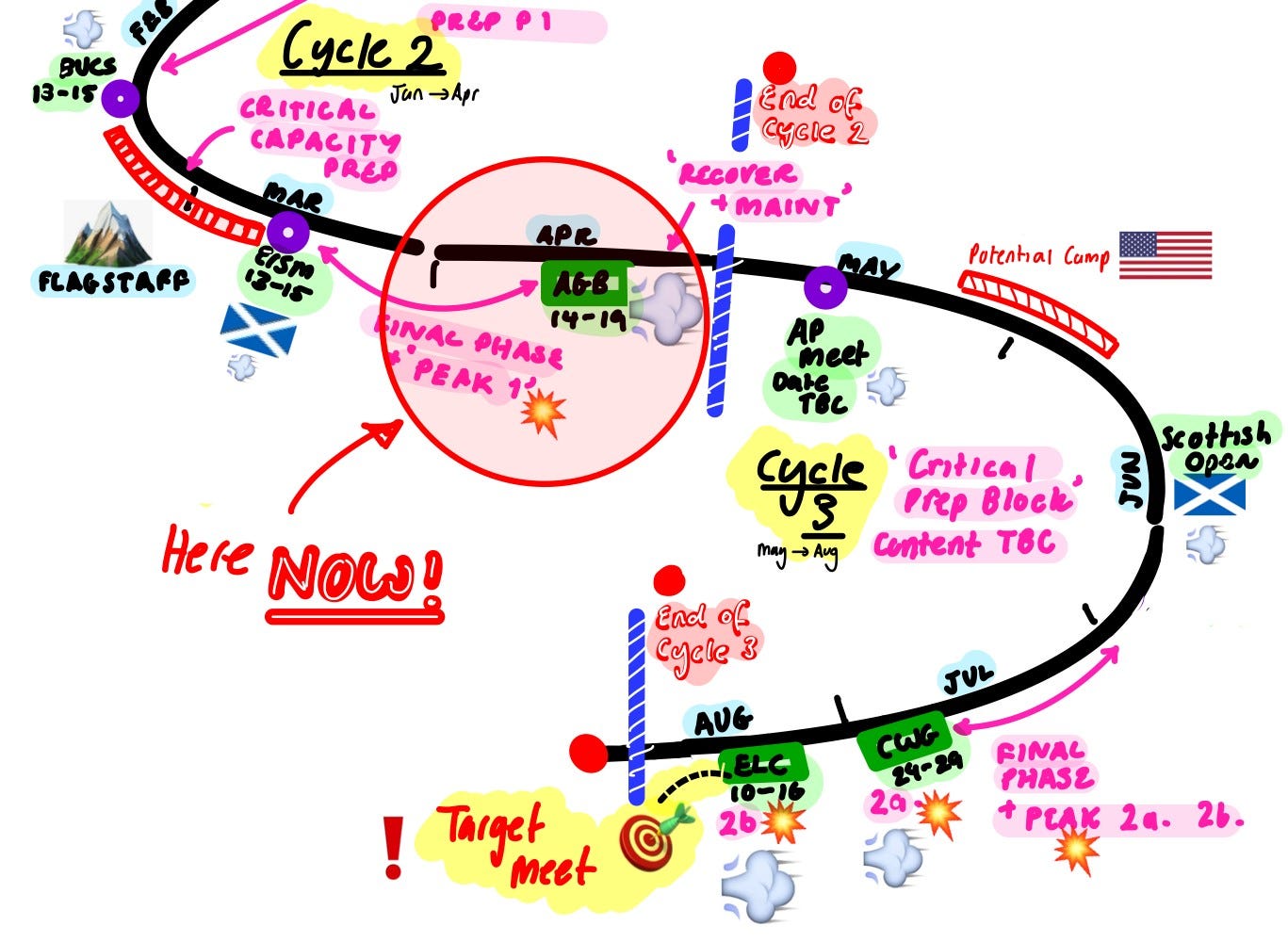
The Reality of Timing and Turnaround
After April championships finish, there’s a natural instinct to give swimmers a few days to breathe. They’ve just come through a long and demanding week - physically and mentally – and I think that space is important.
But the reality is that within a week, you’re already back in, and Cycle 3 has started.
And when you actually look at the calendar, Cycle 3 is often shorter than it first appears. Depending on the year, you’re looking at around 11-12 weeks to British Summer Nationals, 12-13 weeks to Commonwealth Games, or maybe 14 weeks to European Championships.
For many athletes, that’s a relatively short window to continue progressing towards something meaningful - especially when a lot has already been invested in Cycle 2.
On top of that, not every swimmer is heading towards the same outcome. Some are preparing for significant international championships; others for domestic meets, and some for competitions slightly outside the norm.
Within one group, that can create very different needs, very quickly. From a coaching perspective, that adds complexity.
April – The Hidden Risk
April is the first point in the season where performance really matters. It’s where swimmers want - and often need - to be close to, or at, long course personal best form. Selections, opportunities, and direction for the rest of the season can all sit on those swims. Because of that, there’s always a temptation to push.
What I’ve reflected on over the years is that if we push too hard - particularly if Cycle 1 and 2 become heavily loaded - swimmers can often produce their very best performances in April. On paper, that looks like success.
But what can follow is a struggle to make progress.
I’ve coached swimmers who delivered performances in April that, in hindsight, would have been podium-level swims at Olympic or World Championship level. But when we got to the summer, they were close - just on the wrong side of their very best performance.
We live in a sport where fingertip finishes are real, and I’ve experienced multiple times where the swimmers I coach have been close, but not quite close enough. That’s a difficult place to sit as a coach.
You naturally ask yourself whether the season could have been paced differently. Whether too much was invested too early. Whether you were slightly drawn into chasing the April performance, rather than holding something back for later.
I don’t think there’s ever a perfect answer. But I do think it’s an important reflection.
What Does Progress Actually Look Like After April?
One thing I’ve become more comfortable with over time is that progress in Cycle 3 doesn’t always need to look like swimming significantly faster. If an athlete delivers a personal best in April, then reproducing that performance in a higher-pressure environment in the summer can absolutely be viewed as progress.
Of course, we still want improvement. But often, the gains between April and July or August come from smaller, more precise areas:
tactical execution
technical refinement
or improved psychological control under pressure
In that sense, Cycle 3 becomes less about building fitness and more about understanding performance.
It becomes about asking: where is the time actually coming from now?
Keeping Progress Alive: Staying Connected to the Work
One thing we’ve become more aware of over time is how easy it is for progress to drift after April.
At that point in the season, it’s not usually about doing more. It’s about staying connected to the things that actually matter. And for us, that’s always come back to process.
It’s easy to sit down at the start of a cycle, set some outcome goals, and feel motivated. But what carries you through weeks of training - especially in a shorter cycle like this - are the smaller, daily focuses. The process goals.
The technical details. The good habits. The main things that make a difference to the race performance.
The challenge is that in a high-volume, physiologically driven environment like swimming, those things can get lost. Training becomes busy, weeks move quickly, and before you know it, you’ve drifted slightly away from what actually makes the difference.
So in Cycle 3, we try to stay close to the process goals. As a team, we make sure we’re regularly checking in - asking whether the things we’ve identified are actually being worked on, whether they’re improving, and whether they still feel relevant as we move towards the target competition.
Because ultimately, those areas are going to be exposed when it matters most - at race pace, under fatigue, and under pressure. And if we’ve stayed connected to them, there’s usually still something to come.
Weeks 2 and 3: Where Cycle 3 Really Starts Taking Shape
Week 1 is usually about re-entry. Helping athletes find some rhythm again. Giving the support team a bit of direction.
But for me, Weeks 2 and 3 are where Cycle 3 really begins to take shape.
In Week 2, we spend time revisiting race performances with the swimmers. These are some of the most valuable hours in the entire cycle. We sit down together and let the conversation develop naturally. We cover a lot - physical, technical, tactical, psychological details - but most importantly, we connect it back to what’s been happening in training.
It’s the athlete’s space. As coaches, it’s easy to feel like we should have all the answers. But the reality is, the athlete is the one doing the work every day. They feel what works, what builds confidence, and what has not quite landed. Their insight is invaluable.
Some of the best ideas we’ve had this season have come directly from those conversations. Athletes reminding us of things that have drifted out of the programme. Suggesting small tweaks. Opening up areas we hadn’t fully considered.
And beyond the ideas themselves, those conversations build real partnership. The swimmer feels heard, invested, and aligned - and that matters when you’re heading into a championship in 12 weeks’ time.
Small Changes, Big Outcomes
Sometimes, Cycle 3 progress comes from surprisingly small details.
Last season, I worked with an athlete who produced a lifetime best in the 200 freestyle in April. Watching it live, it looked very strong. But when we reviewed it closely, the turns stood out. They were exiting slightly on the side, taking multiple kicks to rotate, with a relatively shallow underwater phase. It wasn’t poor - but it wasn’t optimal.
So rather than overhauling the programme, we kept most things stable and focused on that one area.
Over the next 12–14 weeks, we worked on exiting slightly deeper, rotating prone quicker, adding one more effective dolphin kick, and conditioning them to hold that under fatigue.
At World Championships, they improved again - by around 0.8 seconds. The turn phases were a significant proportion of that.
From the outside, that improvement might look like more training or more fitness. In reality, it was targeted, consistent attention to detail.
The Role of the Team
We also created space for staff to align around process goals.
The brief was simple - if you felt you’d contributed to progress, or even just to the attempt at progress, share it. No pressure to have the perfect answer or a finished outcome. Just bring something to the table.
Those conversations have been powerful.
What’s been interesting is that they haven’t always been about big interventions or major changes. Quite often, they’ve been smaller observations - something noticed on poolside, something picked up in the gym, or a link between what we’re seeing physically and what’s happening technically in the water.
We’ve got a really talented group of practitioners, many coming from different sports. Bringing those perspectives together has been a real strength. They see things slightly differently, ask different questions, and sometimes challenge assumptions that have just become part of how we work in swimming. At this level, better outcomes are often shaped by small, shared insights.
A conversation that starts with one idea can very quickly open up another layer and before long, you’ve got a clearer understanding of what might actually move performance forward. Not in a dramatic way, but in the kind of marginal way that adds up over time.
And I think that’s been one of the biggest shifts for us as a team - creating an environment where those ideas can surface, be explored, and actually influence what we do. Because ultimately, no single coach or practitioner has all the answers. But collectively, if you create the right space, you tend to get closer to them.
How I Now Approach Cycle 3
Where Cycle 2 often feels heavily physiological, Cycle 3 is more about learning how to study performance.
I find myself coming back to a few key questions:
What does the race actually tell us?
Where was time lost, even in a good swim?
Can we refine what’s already there, rather than change everything?
Is there a small shift that could have a meaningful impact?
Those questions sound simple, but the challenge is in how honestly you’re willing to answer them. Especially when the performance has been very good.
It’s easy to look at a strong swim and feel like everything is in a good place. But often, when you look a little closer, there are still moments in the race that can still be improved. That’s where most of the opportunity in Cycle 3 tends to sit.
I also reflect on what we’ve done earlier in the season. If we’ve already used all of our hardest work in Cycle 2, it becomes difficult to see where progression comes from. And that’s where restraint earlier in the year really matters. Leaving space for some physiological progress rather than trying to extract everything too early.
Because in Cycle 3, it’s rarely about finding something completely new. It’s about understanding what’s already there, and seeing how far it can still go.
Cycle 3 becomes a lot clearer when the focus is specific and shared. When everyone - athlete, coach, and support team – understand what matters, where the gains are, and how they’re going to be pursued over the next 10-12 weeks.
And when that clarity is there, the work tends to feel more purposeful. More focused. More effective.
Final Thoughts
This isn’t the only way to approach Cycle 3.
There are a lot of very good coaches doing things differently, and that’s part of what makes coaching interesting.
But for me, using April as a reference point, and focusing on identifying where progress can realistically come from, has proven to be a really effective way of moving things forward.
And if Cycle 3 sometimes feels uncertain, slightly messy, and hard to fully get hold of… that’s probably quite normal.
Like most parts of coaching, it’s something we’re all still learning.
Thanks for reading ‘Beyond the Blocks’ :-)